Your Pelvic Floor After a C-Section: What You Should Know About Recovery

Your pelvic floor has been through more than you think.
If you had a C-section, does that mean your pelvic floor was unaffected?
Not exactly.
While your baby didn't pass through the birth canal, your pelvic floor still experienced nine months of pregnancy, adapting to a growing uterus, changing hormones, and increasing physical demands.
A C-section may protect against some of the mechanical stresses of vaginal delivery, but it also introduces a different recovery process involving the abdominal wall, scar tissue, and the way your body moves.
The mode of delivery is only one part of a much larger story.
What does the research actually show?
Let's start with the good news: research suggests that C-section delivery is associated with a lower risk of certain pelvic floor disorders compared with spontaneous vaginal birth. But lower risk doesn't mean zero risk.
These are estimated cumulative rates from an observational study of 15 years, not predictions for every individual:
Pelvic floor condition | Vaginal birth | C-section |
Stress urinary incontinence | 34.3% | 17.5% |
Overactive bladder | 21.8% | 14.6% |
Pelvic organ prolapse | 30.0% | 9.4% |
So even among women who delivered by C-section, the estimated cumulative incidence of stress urinary incontinence reached 17.5% over 15 years.
Cesarean birth brings its own unique physical recovery process
A C-section is a major abdominal surgery
To deliver the baby, the surgeon works through several layers of tissue, each handled differently.
Although your abdominal muscles are usually not cut during a C-section, the surrounding tissues still need time to heal. Healing also involves small nerves, blood vessels, and connective tissues, which helps explain why numbness, sensitivity, or a pulling sensation around the scar can occur.
This is why C-section recovery is not simply about waiting for the skin incision to close. The deeper tissues are healing too, and rebuilding comfortable movement and strength takes time.
Understanding how each layer is handled helps make sense of post-op core and pelvic floor symptoms:
Layer | During Surgery | Understanding the Layer |
1. Skin | Cut | It's typically a horizontal incision low on the abdomen near the pubic hairline. |
2. Subcutaneous Fat | cut or separated | Sometimes gently parted bluntly to minimize bleeding |
3. Fascia | Cut | A strong connective tissue covering the rectus muscles, and that it is typically sutured closed. |
4. Rectus Abdominal Muscle | Not Cut | Usually separated along the midline |
5. Peritoneum | Opened, often bluntly | It is a thin membrane lining the abdominal cavity and covering many internal organs. |
6. Uterus (Myometrium) | Cut | Typically, it is a low transverse incision = horizontal incision across the lower part of the uterus. Other types of uterine incisions may be used depending on the baby's position or other complications. |
7. Amniotic Sac | Ruptured or opened | Opened to allow delivery of the baby |
And for the Visual learners:

Understanding the Surgical Impact
Understanding how surgery affects your core and pelvic mechanics helps make sense of post-op symptoms:
Incision & Soft Tissue Healing: Pain, tissue healing, and protective muscle guarding can temporarily affect how your abdominal muscles and pelvic floor work together in daily movements.
Early Protective Movement: Post-surgery pain and incision protection naturally cause you to move more cautiously or brace strongly. While helpful for short-term protection, lingering bracing can restrict breathing, posture, bed mobility, and walking over time.
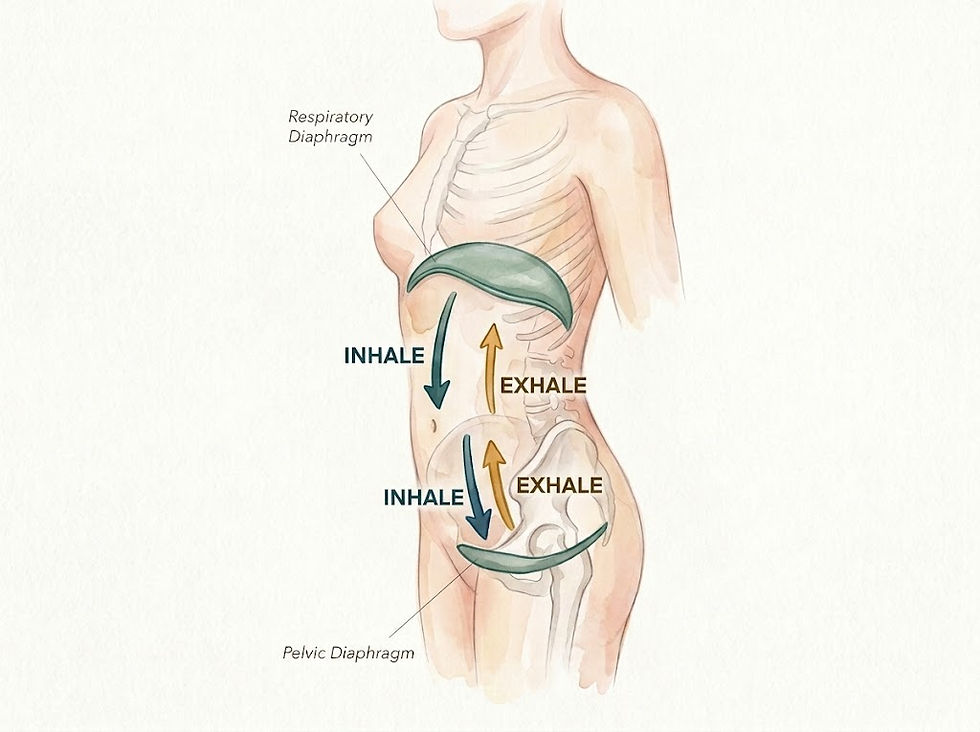
Shared Pressure Mechanics: Your pelvic floor, diaphragm, and abdominal wall work together to manage pressure inside your abdomen.
Following surgery, pain, muscle guarding, and changes in movement may temporarily affect this coordination. While these changes can contribute to discomfort or movement difficulties, symptoms such as urinary leakage, pelvic heaviness, or bowel changes may have multiple contributing factors, including the effects of pregnancy itself.
Labor Before Delivery: A planned C-section before labor and a C-section after hours of labor or pushing can involve very different pelvic floor experiences. Even when the baby is ultimately delivered by C-section, the pelvic floor may have already experienced significant pressure and stretching during labor.
Body System Responses: As with any surgery, there is a possibility of surgical site infection, heavy bleeding, localized nerve irritation or numbness near the scar, and temporary digestive changes like gas retention or constipation from anesthesia and reduced mobility.
C-Section Pelvic Floor Recovery: 5 Ways to Support Your Healing
Recovery after a Cesarean shouldn't be limited to "waiting for the incision to close”.It's about gradually restoring comfortable movement, strength, and coordination throughout the trunk and pelvis.
Start with your breath
Breathing is one of the simplest ways to reconnect with your muscles and pelvic floor after surgery. Start gently, without forcing movement or creating any discomfort around your incision.
Reconnect with your breath- Begin by simply noticing your natural breath. Feel how your chest and abdomen move as you inhale and exhale, without trying to change anything.
The goal is awareness, allowing your body to relax and gradually becoming comfortable with movement again.
360° Diaphragmatic Breathing: Once you're comfortable, begin exploring a fuller breath. Imagine your rib cage expanding in all directions - forward, sideways, and into your back.
As you inhale, allow your ribs to expand and your pelvic floor to gently yield. As you exhale, let your ribs soften and your pelvic floor naturally recoil.
This practice encourages rib cage mobility and helps you explore the coordination between your diaphragm, abdominal wall, and pelvic floor, without forcing abdominal contractions.
More about the connection between breathing and pelvic floor function
Gradually return to movement
Gentle walking, circulation exercises, and comfortable daily movement often begin early in recovery, guided by how you are healing.
In the early days, gentle walking, comfortable position changes, and getting out of bed with support can help you regain confidence in movement.
As healing progresses - gradually rebuild abdominal and pelvic floor strength rather than jumping straight back into your previous exercise routine.
Focus on your hips, core, and pelvic floor so you can carry, climb stairs, and return to higher-impact exercise with confidence.
Pay attention to your scar
Once the incision is completely closed and healed, and your healthcare provider has cleared you, gentle touch and scar mobilization may help you become more comfortable with the area and address sensitivity or restricted movement
Scar massage isn't about breaking up scar tissue, and it shouldn't be painful.
Don't forget your pelvic floor!
You may experience urinary leakage, pelvic heaviness, or difficulty coordinating your pelvic floor muscles.
Depending on your symptoms, you might need strengthening, relaxation, breathing exercises, or changes in how you move and manage pressure.
Make bowel movements easier
Constipation is common after a C-section, particularly with reduced mobility and certain pain medications. Straining can also be uncomfortable while your incision is healing.
Stay hydrated, eat fiber-rich foods, move gently when possible, and consider using a small footstool while sitting on the toilet.
If constipation persists, ask your healthcare provider whether a stool softener or laxative would be appropriate.
When to get Immediate Medical Care:
Urgent issues - such as increasing redness, warmth, or drainage from the incision, fever, heavy bleeding, severe or worsening pain, chest pain, or shortness of breath - require immediate medical evaluation rather than exercise adjustments.For non-urgent symptoms like leakage, heaviness, or scar tightness, pelvic health physical therapy provides a clear, progressive path forward.
Please, don’t wait until symptoms become severe to seek support.
Pelvic floor physical therapy can help assess how your muscles are functioning, whether they need strengthening or relaxation, and how your abdominal wall and pelvic floor coordinate during movement.
Recovery is about more than regaining strength. It's about feeling comfortable, connected, and confident in your body again. And whether you gave birth vaginally or by C-section, you deserve the time, guidance, and support to get there.
References
Blomquist JL, Muñoz A, Carroll M, Handa VL. (2018). Association of Delivery Mode With Pelvic Floor Disorders After Childbirth. JAMA, 320(23), 2438–2447. https://pmc.ncbi.nlm.nih.gov/articles/PMC6583632/
American College of Obstetricians and Gynecologists (ACOG). Cesarean Birth. https://www.acog.org/womens-health/faqs/cesarean-birth
ACOG. (2020). Physical Activity and Exercise During Pregnancy and the Postpartum Period. Committee Opinion No. 804. https://www.ovid.com/jnls/greenjournal/fulltext/10.1097/aog.0000000000003772~physical-activity-and-exercise-during-pregnancy-and-the
ACOG. (2018). Optimizing Postpartum Care. Committee Opinion No. 736. https://www.acog.org/clinical/guidance/committee-opinion/2018/05/optimizing-postpartum-care/


Comments